

Zak
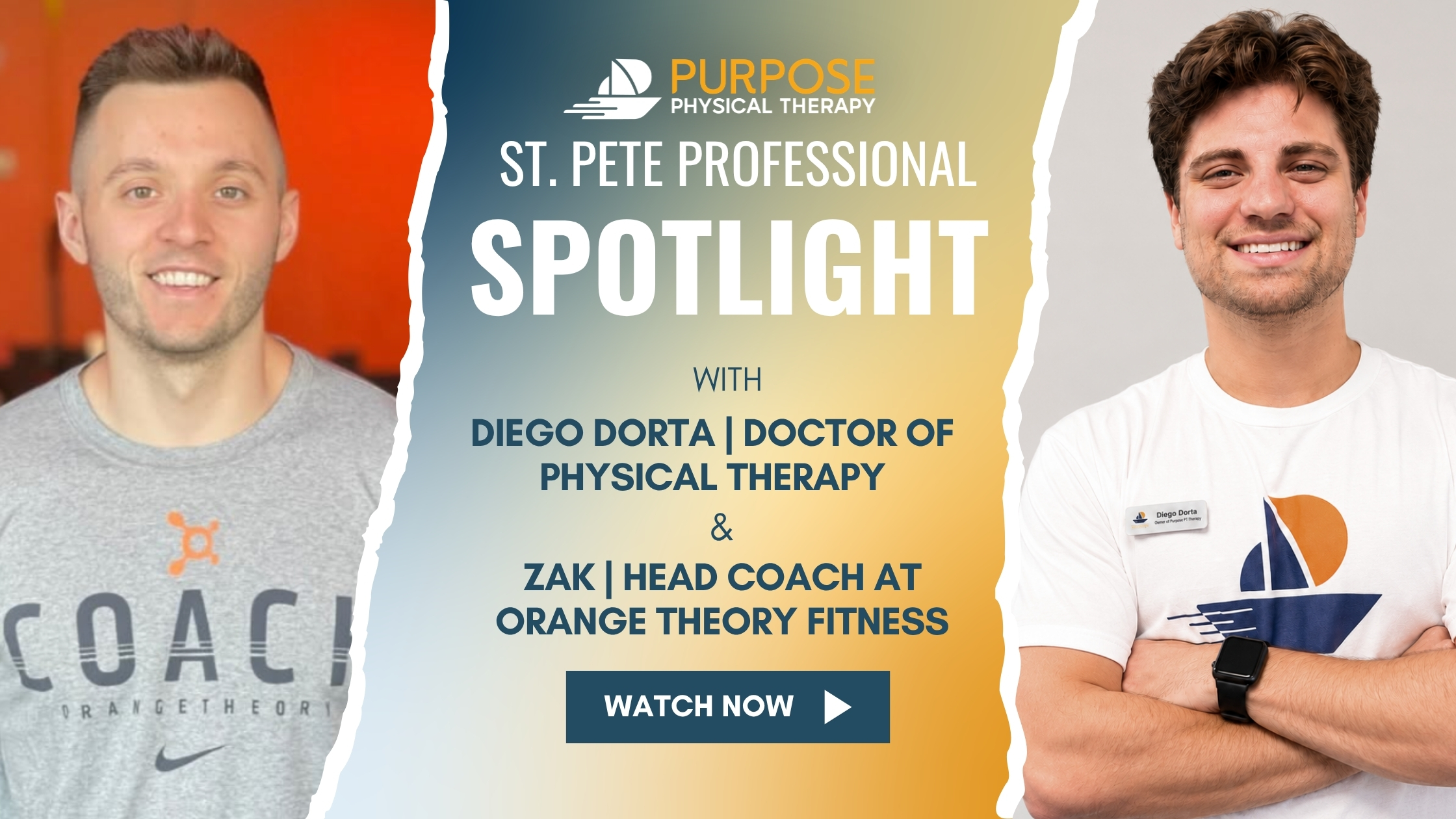
Topic: What a St. Pete Orangetheory Head Coach Wants You to Know About Fitness
Guest Name: Zak
Guest Credentials: Head Coach at Orangetheory Fitness
Discussion Details:
In this episode of our St. Pete Professional Spotlight Series, we sit down with Zak, Head Coach at Orangetheory Fitness Downtown St. Pete, to talk about what really creates lasting progress — both inside and outside the gym.
From helping first-time gym-goers feel comfortable walking through the door to coaching athletes toward new personal records, Zak shares why fitness isn’t just about working harder. It’s about consistency, understanding the why behind your training, challenging yourself appropriately, and finding a community that keeps you coming back.
Benefits of Watching:
Tune in as we explore:
- What makes Orangetheory’s approach to training different
- Why slowing down and focusing on quality can actually improve your workouts
- The biggest mistakes Zak sees people making in the gym
- Why consistency matters more than the occasional “perfect” workout
- How heart-rate-based training helps individualize a group workout
- How Orangetheory adapts training for beginners, athletes, older adults, and those working around injuries
- Why sleep, nutrition, recovery, and what you do outside the gym matter just as much
- The role community and accountability play in creating lasting change
Address of Guest’s Business:
640 1st Ave S, St. Petersburg, FL 33701
My biggest takeaway is just seeing like member success. Like when someone accomplishes something they didn’t know that they could. It’s okay to feel uncomfortable in this sense, but sometimes it’s being uncomfortable that’s gonna push you into the place that you wanna be. I think here at Orange Theory, we do a great job of being family. When you come through the doors, you know, we’re gonna welcome you in right away.
Welcome everyone to another episode of the St. Pete Professional Spotlight Series. I’m Diego Dorza, Doctor of Physical Therapy with Purpose Physical Therapy. Today I’m joined by Zak, Head Coach at Orangetheory Fitness in downtown St. Pete.
As many of you know, Orangetheory has become one of the most recognized fitness communities in the country, helping people of all ages improve their strength, cardiovascular fitness, and overall health. But beyond the workouts themselves, what really sets Orangetheory apart in our eyes is a supportive community that helps people stay consistent and reach their goals. And all of this starts with the coaches.
So today we’re going to talk about Zak’s journey into coaching, what makes Orangetheory unique, some of the biggest fitness misconceptions that he sees, and practical advice for anyone looking to become healthier and more confident in their training habits.
So Zak, thanks so much for taking the time to join me today.
Yeah, thank you. Thank you for having us. Excited to be here, excited to chat with you, excited to talk to people about Orangetheory a little bit.
Yeah, it’s going to be fun. What first kind of got you interested in fitness?
So growing up, my family, we were all very close. I grew up close to them, but not everybody cared about their health the way that they should. So that kind of inspired me to go to school for something health-related. I knew going to college; I grew up in Northwest Indiana and went to Indiana University, so I knew that’s the direction I wanted to go. I didn’t know exactly where in that field I wanted to be, but I knew it was fitness-related, health-related, and trying to help people improve their lives. So that’s kind of what led me there.
I actually graduated during COVID in 2020, so it was just a wild time of life. My girlfriend at the time, now she’s my wife, and I decided to move to Florida during that time. I was looking around, seeing who was looking for people to work, basically. And with my background, Orangetheory kind of fit, and I kind of just fell into it. So I’ve been here for about five and a half years now, and here we are now.
Let’s go. Nice. Kind of dig a little deeper on that. Was there a pivotal moment where you were like, “All right, coaching, that’s going to be it. That’s what I want to do”?
I think it’s just to help people in general. I have the knowledge and the understanding of how the body works and functions and things of that nature. I feel like a lot of people, it’s not that they don’t want to do things, it’s that they don’t know how to do things. You’ll find people in the gym randomly working one muscle group or doing one exercise and they think they’re working something completely different. So just educating, I guess, like the educational aspect.
Like I said, I got into it originally because I wanted to help my family. And because I’m the kid of the family, they’re just like, “Oh, you still don’t know what you’re talking about,” even though you went off to four years of school for it.
Yeah, yeah, yeah, yeah. That’s cool. How’s Indiana? How’s living out there? That’s way different than here in Florida.
Yeah. People are a lot happier in Florida.
Like, just really?
Yeah. Life in general, people are happier. People are nicer. I feel like in Indiana, I didn’t know seasonal depression was real until I moved here, and I’m like, “Okay, it is. It is actually a thing.”
Yeah.
But my time in Bloomington at IU was amazing. I’m sad that they decided to win a national championship after I had left. When I went to school there, you didn’t show up to football games. You would tailgate before the game, then you’d go home. You wouldn’t go into the stadium.
Yeah.
And now I’m like, man, what I would give to be there right now during last year’s run they were on.
Yeah, I mean, I think they’ll still be good this year too. So yeah, if you get back into it.
Yeah, I might have to find my way back up there for a game.
Exactly. So what was kind of your journey once you got to Orangetheory? What kind of led to you becoming head coach? Where’d that go from there?
So head coach, I actually just got promoted about a month ago. I’ve been just a normal coach for about five years or so. And it’s just a constant learning process.
Fitness is always changing, and every day in here is different. The workout itself is different, but the people in here are going to change. What people need is going to change. People change as far as what their limitations are and what their goals are. So it’s constantly evolving, and I think that keeps things fresh and kind of keeps you on your toes, where it’s not necessarily like the nine-to-five where you clock in, clock out, and do the same thing every day. Groundhog work every day. There’s something different to tackle.
Yeah. And now being in this head coach role at the downtown St. Pete location, same thing as far as coaching. Nothing really changes there, but now I just have more responsibilities. I’m able to do more outreach things, able to have better member engagement as far as reaching out, making phone calls, text messages, emails, things like that. So more responsibilities, but also a little bit more fun and more fulfillment as far as helping people more hands-on in a sense.
Yeah, cool. I think that’s something I always talk about, and we share similarities in our profession, where you come into work and you could have a completely different day than you had yesterday.
And even if you’re working with the same people, because it’s constantly changing. What we do is taking where they were from yesterday, we apply a stimulus, then we see how they adapted, and then we continue to grow from there.
So it’s so fun to just keep solving this never-ending puzzle.
It truly is, yeah. I really do love that.
Yeah, that’s cool. Would you say that’s what you enjoy most about coaching, or is there something else?
Yeah, I mean, I would say so. I think my biggest takeaway is just seeing member success, like when someone accomplishes something they didn’t know that they could.
We do something here called benchmarks. For instance, yesterday we had a one-mile benchmark. It’s basically just a performance test. So rather than just hopping on a scale and seeing, “Oh, my weight’s changing,” we actually do in-studio, workout performance-based benchmarks to see where you are, where you were, and where you’re going. So it’s one mile, get on the tread, and we say go. Of course, we coach you through it, motivate you through it, things like that. But the amount of people that got off and had new personal records, like, “I beat mine by 20 seconds. I beat mine by 30,” and they’re just feeling so accomplished and successful, that’s the rewarding part to me.
Or even people that didn’t realize they were going for it that day. They’re like, “Oh, I don’t feel great today,” and then here they come and beat their time by 10 seconds. Things like that are just the rewarding parts of what I get to do. It’s crazy how often you see that. People come in, they’re like, “Oh, I’m hurting today. We’re going to take it easy. Don’t push me today.” And then we end up doing way more than what they did the day before.
Yeah. I feel like sometimes I tell them the days that you’re not feeling it are the days that you didn’t know this was coming. For some people, it’s like, “Oh, I didn’t realize there was a benchmark.” I was like, “Well, this is about to be the best performance you’ve ever had.”
Oh, yeah. You didn’t think about it. You weren’t thinking about it prior, just coming in and doing it, so you didn’t have that time to kind of stress about it or play it in your mind about what you were going to do and things like that. Sometimes that’s when the best performance comes.
Yeah, exactly. Having no expectations there.
Yes, exactly.
Do you have a member, a specific member success story that has stuck with you over the years?
Oh man, there are multiple. There are multiple.
I think one of the biggest ones so we do something called the DriTri here. It’s basically our version of a triathlon. You do a longer row, you do weight and bodyweight exercises on the weight floor, and you do a longer run.
The way that the members will rally around the ones that need it is the most rewarding part and the most gratifying part.
For instance, you get a 90-minute time block to do it. Once we say go, you just go around the room at your own pace. You’re going to have people that are really fast and finish this thing in 30 minutes. You’re going to have people that take longer and go up over an hour, because everybody’s at a different place in their journey.
But it’s those people that finish in that half hour that see that person still on the tread at that hour mark, that then hop back up there and run with them the rest of the way. That just warms your heart a little bit, you know what I mean?
Yeah, that’s awesome.
Yeah, it’s so cool to see people have successes like that.
That’s so cool.
Okay, let’s kind of shift our focus and talk a little bit more about Orangetheory specifically. For someone that’s never stepped foot in an Orangetheory, how would you describe what to expect?
Yeah, so it’s a 60-minute workout. It’s going to be full body. About half your class is going to be cardio-based, like on the treadmill. The other half is going to be a mix of strength, endurance, weight floor, and resistance training. We have TRX straps, we have dumbbells, we’ll work with BOSU balls, mini bands, things like that. Every day the workout is different, so it keeps you fresh and keeps you on your toes.
As far as what we’re doing on the treadmill, if you’re a runner, we do some running. If you’re a power walker, we’ll use incline and lower speeds. So yeah, you get the full-body experience in an hour. It’s heart rate-based. Everybody’s wearing a performance tracker on their arm, so in real time, you see what your heart rate is on the screen. And that’s what coaches coach to as well.
Like, “Hey, this is what we’re doing right now. This is how it should feel. This is where your heart rate should be. Is it there? Perfect. Is it not there? Okay, let’s work a little bit harder to get there. Is it too high? Let’s take it down a little bit. Hey, we’re working too hard.”
So that’s just a way that we can measure to make sure that people aren’t overtraining or undertraining. Yeah, no, I think that’s awesome. I did an Orangetheory class a few years ago, and that was my favorite part about it. That constant objective feedback is so fun, especially for someone probably like you too that’s kind of a nerd about this stuff.
Yeah, exactly.
So cool to just be like, okay, well, I know I want to hit this benchmark. Maybe for this next one, I got to bring it down a little bit or bring it back up. Feedback is so fun. Right. And we track things called splat points, which is time spent in what we call the orange and the red zone.
That orange zone is going to be like 84 to 88 percent of your max heart rate. We calculate it all in our system, and that’s going to be on your arm, again, the performance tracker. It’s reading throughout class what we want. We want to get 12 or more minutes into that zone, and that zone is your anaerobic zone, so your muscles are working without oxygen.
So if you spend 12 minutes in that anaerobic zone, you leave the workout, your muscles are trying to get that oxygen back into the body. As a result, your metabolism can be boosted after your workout. Then we also have the green zone, which is your aerobic zone where your muscles work with oxygen, and that’s where you burn the most calories.
So it’s like, hey, spend a bunch of time in the green zone, let’s get our 12 or more splat points. There are different things to look at. Some people go as far as looking up on the screen to see who’s doing what if they have a friend in class. They’re being competitive, trying to beat them.
That’s what I did.
Yeah, yeah. That was so fun.
Yeah, yeah. So not just lifting heavy, but let’s see who’s working harder, because everybody’s at a different place. Someone may lift 20 versus 30 pounds, but we can all measure our effort the same way to know I worked just as hard as you did, even though it wasn’t as fast or as heavy or whatever the case may be.
Yeah, for sure. That’s awesome. As a coach, how much of that education do you provide during your typical session? Is that varied between the people?
It’s pretty constant as far as coaching to what the heart rate is at. It’s going to change as far as what the actual workout is. Like, if it’s a power day on the treads, we’re doing all-outs, and we’re doing walks for the most part. So we’re going to spike the heart rate, then we’ll drop it low. We want to hit max effort, then we want a full recovery so we can maintain max effort.
Whereas if it’s an endurance day, it’s like, hey, we want to see a gradual increase in that heart rate. Then we want to see you be able to drop it a little bit because what we’re doing is running in intervals. Then we want to see you take it up a little bit higher, drop it back down, and take it back to a steady place.
There’s also days where we’re going to run with a little bit of incline on the treadmill, which is going to help you build strength in your lower body. That’s going to feel just like one of those endurance days, but in a different way, where you’re building muscle and strength in your lower body while you’re running.
So it’s constantly, every day, you’re looking at the screen, you see what the workout is, and you’re finding a way to get the message across to the members that this is how you should feel and when you should feel it.
Yeah. Cool.
As far as your guys’ location, the experience that you guys have created, what’s the atmosphere like? What can you kind of expect if you’re going into your first class working with you?
Yeah, I think everybody in our community is very welcoming and supportive.
I think if you come and take your first class and you’re 6:05, and you’re like, “Hey, I’m going to be 6:05 Monday through Friday,” well, guess what? There’s about 20 other people who are also 6:05 Monday through Friday, which is a good thing.
Because now if you miss a day, you come back on Thursday, and all of a sudden people are like, “Hey, where were you at yesterday?”
Yeah, that accountability. That’s awesome.
Yeah, it’s a very unique community in that sense where everybody is kind of holding each other accountable. It’s a super positive atmosphere. Everybody is here to improve something, whatever their goal may be.
We have people that are looking to run marathons, people that are training for HYROX, and people just looking to improve their health as far as maintaining their ADLs and continuing to be independent in life for the older members.
So the range is anywhere from people 14 to 80 years old. For real, we help and train everybody.
Cool. No, that’s awesome.
You mentioned HYROX. That has skyrocketed in the past few years. Has that kind of transferred now to you guys? Do you get a lot of people wanting to do that?
So we do a little bit of it now. We do some HYROX training classes. My location in downtown St. Pete offers two training classes: on Wednesday at noon and on Saturdays at 8:45.
They’re workouts that are meant to elicit the same heart rate response, the same feel, and the same amount of fatigue that a HYROX would give you. We’re working muscle groups on the weight floor that you’re going to be using for the HYROX.
Anything that we’re doing is geared up for your success during the HYROX. We’re not going to throw in something random in those training sessions that wouldn’t benefit you for that actual race.
Yeah, cool. I think you guys are really well equipped to transfer your training toward some HYROX-focused training, especially with the heart rate information and all the endurance training you guys already do. That’s really, really good.
Yeah, awesome.
So with so many different types of gyms and training available today, what do you think makes Orangetheory unique? Why are you guys special?
I think it is because of that wide range of people we can help. Like I said, we have people that are 14 years old and people that are 80 years old, and this workout works for each one of them individually.
The coaches here guide you through the workout. We push you through the workout. We challenge you. We give you options if you need those options.
Like I said earlier, you can run, you can jog. There are things that we do on the weight floor where we’re jumping. Well, we can’t jump? Okay, let’s give you an option where you’re doing the same thing, working just as hard, but in a way that’s more beneficial for you.
So it’s group fitness, but it really is like personal training at the same time. The coaches are around the room leading everything and watching everyone all at once, basically leading the treads through what they’re doing, but also keeping an eye on the weight floor and seeing if anybody needs help with anything.
I think that’s kind of the unique aspect that we bring.
No, that’s cool. You’re in the fitness space, and I’m in it too. I’m always looking on social media or checking people out in the gym. What do you see? What’s kind of the biggest mistakes you see people make that you wish you could kind of say, “Hey, let’s just try to focus on this”?
I think there’s a couple of things. The first one that I see a lot is rushing through the actual lift and not getting everything out of it that you can.
It’s not about doing it fast. It’s about the quality of the rep.
If you’re doing a squat, for instance, it’s not about going down and up as fast as you can. The slower you go, the longer under tension those legs are, and it’s going to break down the muscles. They need to be built back up stronger.
So if we’re using a slower tempo, what we’re doing is increasing time under tension in the lower body.
That’s kind of one big one. People think, “Fast, fast, fast. I have to go quick. That’s how I’m working hard,” when that’s not always the case.
So telling those people, reminding those people, like, “Hey, let’s slow down. Take your recovery. It says rest on the screen. We said rest because what we want you to do is recover so you can lift heavier when that second one comes around.”
Does that make sense?
Yes, yes, 100 percent.
Yeah, I’m sure you deal with the same thing.
Yeah, man. The biggest thing I see all the time is rest. People just want to think, “I’m working out. I’m here. I’m going to get my things, hit my sets, go to the next.”
They think it’s a race.
Yes, exactly. We always have to remind them, “Hey, rest is important. We want you to get your most output out of every set.” That’s the goal.
And so if you’re not rested and you’re still recovering from that last set, then this next one you’re going to do is not going to be your 100 percent.
Right.
Yeah, 100 percent. Exactly. It’s always something we deal with.
And then the second thing that comes to mind right away, we kind of touched on it earlier too, is just people not understanding what we’re doing and why we’re doing it.
The next one is just educating people on what we’re doing and why we’re doing it.
A lot of times, people start doing lifts or exercises that we’re not coaching. It’s not because they’re wanting to not listen to us. It’s because they don’t understand what they’re getting out of it.
So just educating them on why we’re doing a hip bridge, or why we’re doing a squat, or where you’re feeling this movement, or where you should feel this movement.
So it’s not that they aren’t wanting to do the workouts. They don’t understand why they’re doing it or what that muscle group is that we’re working.
It’s about educating on the purpose and the why behind things.
Yeah. No, it’s important for us too. They come in for hip pain and we start working on their glute strength, and they’re like, “Why are we doing this? It hurts on the side of my hip. Why aren’t we doing something else?”
So that education portion is so important for a lot of people.
Definitely can.
Okay, so you’ve coached a lot of different people in your time. What separates the members that are making lasting progress from the ones who kind of struggle to stay consistent and meet their goals?
I think a couple of things. Consistency, getting in here.
If you’re going to commit to three days a week, let’s see you in here three days a week. If that is your goal, if that is what you’re working towards, then perfect. That’s how many times we want to see you.
So staying consistent in the routine, finding that routine, finding one that works for you, and committing to it.
I think a lot of it too, we’re with you, you’re coaching, you’re getting coached, you’re at Orangetheory for an hour. That’s a small portion of your day.
So you’re getting the exercise you need, but now what are you doing outside the studio? Are we still moving? Are we still being active? What’s our diet look like?
Are we eating more good things and less bad things? Less ice cream, less sweets, things like that. More salads, more proteins, more fruit. Are we drinking water? Are we drinking soda or pop? Is it more sugary drinks? Is it healthier drinks?
So just getting them to understand that just because you come in here and work out for an hour, you got your 12 splat points, you burned a bunch of calories, we’re not going to go home and sit down the rest of the day, be sedentary, and eat ice cream and pizza.
Yeah, of course, you can have ice cream and pizza.
Yeah, and everything in moderation.
Right. So I think that’s kind of a big separator too, is people realizing that this is part of my day. This isn’t going to change everything. This is the start or this is the end of the day, depending on when they’re taking class, but this is part of the process.
Outside of what I do matters just as much. Finding excuses to go on walks, finding excuses to do any kind of physical activity outside of an Orangetheory workout itself. Just find more ways to move. Move more, sit less.
I think that’s a big thing, especially in our world. We’re all so sedentary. A lot of people work from home and things like that.
Yeah, no, for sure. Even from a rehab perspective, we can strengthen muscles, load tendons, increase range of motion, and do all these things in clinic. But there’s so much research out there just showing how important overall fitness and activity is in terms of improvement in all different types of injuries.
So while what we do is important here, it’s equally important to just try to get your overall health improved.
Yeah, most definitely. And a lot of lower moderate body injuries can be weight-bearing issues as well. So you got knee aches, hip pains, and it could be weight-related, where you lose weight and all of a sudden some of that pressure comes off.
Yeah. It’s a hard conversation to have with some people, but it’s true. It’s all load tolerance. So you can modify load in different ways, and that’s one of them for sure.
Okay, so it’s really important for us to help people start building healthy habits. Part of that, like we talked about, is getting into a gym and getting active. But for a lot of people, that initial start can be really intimidating.
What would you say to someone who’s been thinking about wanting to start going to a gym and start getting active, but they’ve been putting it off because they’re a little scared?
Yeah, I think it’s okay to feel uncomfortable in the sense, but sometimes it’s being uncomfortable that’s going to push you into the place that you want to be.
I think here at Orangetheory, we do a great job of being family. When you come through the doors, we’re going to welcome you in right away.
It’s not going to be like, “Hey, jump into the workout and go.” We will give you an introductory process to get you comfortable with what the structure of the workout is and with all the equipment in the room.
You might even meet a few people that are going to be in that class. I like to introduce my first-timers to the person next to them and be like, “Hey, this is so-and-so. If I can’t get to you, they’ve taken over 300 classes here, so feel free to ask them a question. And when I can, I’ll be right next to you to help you along.”
So I think the first step is just showing up. Then after that, I promise it’s not as uncomfortable or as scary as you might expect it to be.
We want you to be successful. I always want people to leave my classes feeling accomplished, feeling successful, and feeling that they had a good time.
And if we check those three boxes, why wouldn’t you want to come back?
Yeah. Cool. No, that’s awesome.
And I know you’ve touched on it a little bit already. Orangetheory is designed for everyone, right? That could be beginners, experienced athletes, or older adults. You kind of have a good range there.
Yeah, exactly.
For instance, to dive into it a little bit, we do things called pushes. A push is just an effort on the treadmill to get your heart rate higher.
So I’m going to say, “Hey, we’re going into a push. We want the heart rate to come up to this zone. We want to be at this percentage. We want to see this color on the screen.”
But ultimately, you’re hitting that button to decide how hard you personally have to work to get to that place that we’re looking for.
So if you are a power walker, maybe you’re not a runner, and that’s completely fine. You’re not going to change your speed and walk faster. You’re going to take your incline up higher to take your heart rate up higher.
Now, if you’re a jogger and a runner and we’re going for that effort where we’re looking to get uncomfortable, then we add that speed.
Maybe you need six miles per hour. Maybe somebody that runs marathons or is a sprinter is up more toward 10 or 11 miles per hour.
So we use phrases to get to the places and the heart rate responses we’re looking for, but it’s not like, “Hey, you need to be here,” because everybody’s at a different place on their journey.
That’s how we’re able to coach such a wide variety and such a wide range of people.
Yeah. As far as even injuries go, our treadmills themselves are super unique. I’ve never seen any like them because there aren’t any other treadmills like ours.
We have something called Flex Deck, so as you’re striding in the middle of the treadmill, it absorbs your impact. It kind of feels a little trampoline-like, so it helps out your joints, your knees, your ankles, and your hips.
For instance, I had a newer member probably about three months ago. He came in and said, “Hey, I’m going to be a walker. I can’t run because of my knee.”
I said, “Okay, start walking. Feel what this treadmill feels like.”
And he’s like, “Oh, this feels pretty nice. I kind of want to try running.”
I said, “All right, let’s give it a shot.”
He has not walked one time in class yet. Every class he’s in there running because of that impact absorption on the treadmill.
Now, for some people, there may be meniscus tears and they’re coming back slowly off of that, or maybe their lower body injuries are a little bit more serious. We have options as well.
So if the treadmill is not something that works for you, we have bikes and we have a strider or an elliptical. You can still do the same efforts and work just as hard as the people on the treadmill, but in a mode that is better equipped for your body.
Yeah, awesome. That’s such a huge part of rehab in our setting, trying to maintain your activity level but just do it in different ways, right? That might load you in different areas.
Exactly. It’s so important.
So many people come in, they’re like, “Man, I want to go bench and squat. I want to do all these crazy things, but I can’t because I’ve got this pain.”
So you see their mindset and you really want them to not lose that, right? That’s so important for someone’s energy and mental health.
We really just try to work with everyone on finding different areas where they can substitute temporarily.
Right. Substitute so you can maintain your activity level and keep doing what you like to do.
So we do a lot of that on the weight floor. A lot of my older members with lower body limitations, their range of motion is a little bit limited.
It’s like, “Hey, we’re going heavy today. We’re going to lift an aggressive dumbbell. We only want to have six reps here.”
Well, for them, that doesn’t necessarily work. What they need is increased range of motion. They can’t do a full squat. They can’t get low enough.
So we use our TRX straps. They hold the straps and use them to get the squat. The straps are there to help them up.
It’s all about approach with the members too. So I’m like, “Hey, this is where we’re at right now. This is why we’re doing what we’re doing. We want to increase range of motion so we can build from there.”
Doing partial reps is only going to get you so far. What we want is that full range of motion.
Yeah, that’s awesome. We love TRX straps. We use them all the time. They’re great.
They’re amazing.
There’s other ways that we can improve our health. We kind of touched on it before, but how important are things like sleep, nutrition, stress management, and all that for improving your fitness and also for recovery?
Definitely. I think a lot of times we’ll see people come in in the morning, and their performance tracker or their heart rate will reflect what their night looked like.
Sometimes people that I know have a lower heart rate naturally come in, and all of a sudden they’re really high. I’m like, “Hey, what’d you get up to last night? Did you go out to dinner? Did you have any drinks? What did your sleep look like?”
And they’re like, “Oh yeah, I had a few drinks. I stayed up a little bit late, but I’m still here.”
I’m like, “Yeah, that’s great. I could just tell your heart rate’s a little bit higher.”
Yeah, normal.
So it can kind of give you that real-time, “This is what I did yesterday and this is what my impact is today,” which is really cool as a nerd to look at and understand.
But it’s also cool as a person to be like, “Oh, I can actually see how what I’m doing activity-wise or food-intake-wise, or not getting enough rest, impacts my heart rate and how I function and perform on a daily basis.”
Yeah, no, that’s so cool. That’s probably my personal favorite thing that you guys do, those fitness trackers.
Do you wear a fitness wearable, like a watch or something like that?
I have an Apple Watch. I use an Apple Watch. I’ve also tried out the Oura Ring. When I’m working out in the studio, I have the OTbeat, so I use a couple of different things.
Yeah. I really want either a WHOOP or Google just made one, the Fitbit Air or something like that. Just always having that data on myself.
You got to be careful because sometimes you might have a poor sleep score, a poor higher heart rate, or something like that, and you can’t let it affect your workouts.
You can use it as a tool, but not the end-all, be-all.
Yeah, exactly. I feel some people do that.
Yeah. And our performance trackers that we have in the studio, you can’t connect any performance tracker to our equipment. So they’re unique to just us.
It’s a monitor that goes on your arm, and that’s what reflects on the screen. That’s what reflects on your treadmills. That’s what reflects at your rower. That’s what’s reading your pulse and giving your heart rate throughout class.
So you can only see all of that in the studio if you have what we have, which is that OTbeat. But you can use that OTbeat outside the studio as well.
You can use it with Bluetooth connected in your app, in your Orangetheory app. So it’s an Orangetheory thing, but also an outside-of-Orangetheory thing.
Like I said, it makes sure that coaches are making sure you’re not overtraining or undertraining throughout your workouts.
That’s awesome. Is that something members can use on their own time?
Yeah. So on their own, that performance tracker is theirs. They purchase it when they buy their membership, and then they can use it in the app whenever they want.
They turn it on, connect it through Bluetooth, use it in their app, and then after they get done, after they hit finish workout or whatever the case may be, they’ll get a summary of what their heart rate looked like throughout that training session.
So I like to tell people to use it as a tool. If you’re using Orangetheory but you’re also working out elsewhere, that’s completely fine. We don’t have to be the end-all, be-all.
But you can use the performance tracker to measure, “I’m working this hard there versus this hard there. I feel like I’m getting more out of one or the other.”
And then you can actually see the data of whether you’re getting more out of one or the other.
No, that’s super cool. I didn’t know that. That’s awesome.
Yeah, unique.
No, awesome. Okay, now let’s talk a little bit more about the Orangetheory community and kind of how it is here in St. Pete.
We obviously have talked a lot about how important this community is and how cool it is. Can you describe the culture that you guys have and why it’s special?
Yeah, I think everybody’s uplifting. Everybody wants everybody’s best.
Like I said, on a benchmark day, people get off the tread and they’ll talk to the other members on the other side of the room, like, “Hey, how did you do? How was it in there? What were your speeds like today? How was the weight floor? How’s the body feeling?”
So everybody’s super friendly. Everybody’s in here for one goal, and that goal is to improve their health.
It’s never one of those box gyms where you kind of feel like you’re shy off in the corner with all the regulars over here. Everybody in here is family.
I think that’s what’s unique. That’s what separates us from other places.
As a staff, we constantly are holding you accountable to what your goals are and what your plan is.
So if your goal is to lose 10 pounds by the start of the year, whatever the case may be, it’s like, okay, well, we need you in here four times a week.
Then if we’re not seeing you four times a week, we’re going to give you a call. We’re going to shoot you a text and make sure you’re okay, number one, and number two, to remind you, “Hey, this is what you’re working towards. We need you in here this many times if this is what you want to be at, if this is what your goal is.”
Everybody’s different, so everybody’s goals are different. It’s on us to know what those goals are and help members along the way reach each one of those goals.
That’s cool. That’s so important, to have a good family, close-knit atmosphere to create that comforting environment and bring people in and keep them wanting to come back.
Because exercise can be kind of vulnerable sometimes. You’re working hard. Sometimes you’re doing worse than where you want to be, and you want to be around people who you know are going to support you and uplift you.
I think that we do a good job of making exercise fun too. The amount of people that leave after their first class and say, “That was a lot more fun than I thought it was going to be,” to me, that’s also rewarding.
Like, okay, I did my job. I created a positive environment where someone wants to come back to.
Right. If you’re not having fun, why would you do something like that? If it’s not fun, it’s only going to last so long.
Right, because you’re thinking, “I’m forced to do this.” But if you’re having a good time and you want to be there, you’re more likely to continue doing that.
Exactly. And then that’s how you’re going to get those fitness benchmarks that we talked about.
Yeah.
Touching more on the community, we’ll do events as well. We’ve done stuff at breweries where we all meet up. The staff goes, we invite all the member base, and whoever wants to come can come.
We’ve held events at the studio where we bring in vendors. We’ve had people doing cold plunges here. We’ll bring in nutrition shops and things of that nature.
So we bring in other local businesses to help promote them and reach out to our members so that our members have access to all this stuff as well.
So that’s more on the community level. But more in the community aspect too is where we kind of bring in all of St. Pete and we’re all kind of working together toward a healthier life.
Yeah, no, I love that you guys did that. I personally just went and did a pop-up at the Tyrone location.
Okay. Yeah, yeah, yeah.
And it was awesome. Just to see everyone come in smiling, they could come in and ask questions about injuries. I had a treatment table there.
But just to be a part of that community was special. I think it gave me real insight into how you guys work together, and I’m sure it’s the same thing there at your downtown location.
Yeah. So I actually coach at both currently. I coach at Tyrone. I was at Tyrone this morning, and now I’m at downtown right now.
I’ve been at Tyrone for like four years. I just recently, well, not recently, I’ve been here for two, but now I’ve been promoted to head coach here for the past month.
So I’m going to be here primarily, but I’ve been over there for the past four, four and a half years.
That’s awesome. Yeah, it looks like they got a good group over there.
Yeah, definitely. I feel like that’s the theme with all the Orangetheory locations too. The location can change, but the vibes remain pretty much the same from location to location because we’re all preaching the same thing.
Right. I think here in St. Pete, we have such a good fitness community. I’ve lived in Seattle and come from other cities, and it’s different.
I feel like there’s people here, you see them running on the street. Everyone’s always active. We like to go to Vinoy, and you see everyone outside with their dogs.
Obviously, the weather is really helpful with that.
How do you see Orangetheory continuing to grow with the community here?
Yeah, I think that Orangetheory is a great escape from the heat in Florida. I think people love to run, but when midsummer hits and it’s a hundred from 4:00 a.m. to 4:00 a.m. again, you know what I mean? The heat does not let up.
I’m originally from Indiana, so I’m used to the seasons. I came here and I’m like, yeah, the heat’s real. I like it a lot more than winters, don’t get me wrong.
But you can use us as a place to train indoors when outdoors is not ideal for you.
We offer classes called Tread 50, where it’s just 50 minutes of treadmill, just 50 minutes of cardio.
So if you’re someone that’s like, “I already lift somewhere else. I don’t need strength training,” okay, we’ll take one of our Tread 50 classes. Spend 50 minutes training with our endurance, strength, or power workout, and then do it in the air conditioning.
Yeah, there you go.
Oh my gosh, yeah. That’s been brutal. If I’m outside for more than an hour, I’m full sweat for sure.
You got to be either in AC or by the water.
I think that’s right.
Find a breeze. That’s important.
Yeah, find a breeze.
What’s kind of the best way for people watching this? How do they schedule their first class? How do they come get to know you guys?
So you can schedule your first class online. You can give us a call. You can go on our website and see what locations are closest to you.
You can do all your bookings online. You can find us on social media. We’re on Facebook. We’re on Instagram. We’re everywhere.
If you pass the studio and you want to just come in, feel free to walk in. We’re staffed throughout the day, so you can come in and talk to some of our sales associates or even our studio manager. Maybe some of the coaches are there as well.
We’re staffed about 12 hours a day, so you can come in at any time and chit-chat with us and get booked for your first class.
Your first class with us is free, so it’s a trial. See how it goes, see how it feels, and then we’ll get you going on a program.
The coach will prescribe what they think is best for you based on what you tell us your goals are. So we customize what that programming is for you individually.
Some rapid-fire questions before we finish up.
Your caffeine in general, do you do it before or after your workout?
Ooh, before. Gotta be before.
Yeah, before.
Yeah. Unless it’s Orangetheory, because caffeine affects heart rate and it’s heart rate-based. So if you drink caffeine before an Orangetheory workout, results may vary.
But for me, in a personal workout, if I’m just going to lift, I’ll do caffeine before.
Yeah, got to. Got to have a little pre-workout for sure.
Okay. Morning classes or evening classes?
Morning classes.
Morning classes, yeah. I’m the same way.
Yeah, I got to do it. Wake up and get after it. If I have time to wait or time to think about it, you never know what the day is going to bring. Get it done early.
Exactly.
Okay, favorite Orangetheory station?
Ooh, treadmill, because outside of Orangetheory, I would not hop on a run willingly.
Like I said, we make it fun in here, and we have those Flex Decks in here. So I’d say treadmill because it makes me do something I wouldn’t do elsewhere.
Nice. Okay, favorite exercise?
Ooh, that’s a good one. I like thrusters. It’s a full-body motion, full-body workout. You’re going low into a squat, and then you’re using a squat to help hit an overhead press.
So it’s kind of, you know, you’ve got everything working. Everything’s engaged. Everything’s active in that.
Awesome. Least favorite exercise?
Hmm. Probably burpees.
Yeah.
I always feel bad when I have to coach them too. It’s like, guys, I don’t make the workout. I just have to coach the workout.
Don’t get me wrong, they’re good for you. You feel good after, but you don’t feel good during.
I just saw a video of someone doing burpees for a mile.
Yeah, yeah. A track and burpee to a mile.
Oh my.
That’s good. It’s like the HYROX, they do a burpee and then they do a leap forward. They go right into the burpee, and it’s just like jumping’s enough. You want to add a burpee into it too? That’s crazy.
No, that’s awesome. Okay, what do you like more, cardio or strength training?
Strength training.
Yeah, me too. You got to do your cardio, though.
Yeah, you got to do your cardio. That’s why I said my favorite station is treadmill. I’m trying to balance myself.
Self-improvement.
Yeah, exactly.
What’s your favorite post-workout meal?
Ooh, probably Chipotle. Big Chipotle lover, yeah. And I try my best to make two meals out of it, but it doesn’t always work that way.
Oh yeah. I can’t. I eat Chipotle breakfast, lunch, and dinner if I can.
Yeah, exactly.
Okay, what’s your favorite way to spend a day off?
With my wife, with my dog. We like to spend a lot of time outside, beaching.
I like playing golf personally. She’s not a golfer, so that means time away from her. So she probably doesn’t love that I love to golf, but it definitely fuels my competitive nature, that’s for sure.
Yeah, bring her on the cart.
Yeah, I have before. She can just ride along and I’ll tell her what club I need.
Yeah, exactly. You got a personal caddy there.
Yeah, exactly.
No, I love golf too. Same way. You got to just slowly introduce it. Maybe she should play a little bit.
I keep telling her, “I’m going to buy you clubs for your birthday.”
And she’s like, “I didn’t ask for them.”
And I was like, “Yeah, but you’re going to use them.”
Yeah, exactly what she wants, I’m sure.
Yeah, exactly.
If you weren’t a coach at Orangetheory, what would you be doing?
Oh man, good question.
I would probably be something in a business-related field. I’d probably have more of a desk job than I do now for sure, and I don’t think I’d be as happy as I am now.
I think that everything kind of worked out the way it needed to be, and if it didn’t work out this way and I lived a different life where I went to Kelley School of Business at IU, I probably wouldn’t be in the mood I’m in right now.
Yeah, good. That’s good to hear.
What’s one phrase that your members hear from you all the time? Something you repeat all the time?
They make fun of me a lot for it. I have things that I say on each day of the week.
So on Tuesday, I’m always telling people, “Taco Tuesday.” On Wednesday, I’m always talking about hump day. On Thursday, I’m calling it Friday Junior.
So I’m constantly introducing the days of the week to them like they don’t know what day it is. So I get a little bit for that.
You got to have a little, you know, lighten up the mood.
Exactly. Like I said, if it’s not fun, you’re not coming back.
Exactly.
Okay, one word to describe the Orangetheory community. I have an idea from what you’ve told me.
Let’s hear it.
Family.
Family, yeah. You’ve mentioned it a lot.
Yeah, family.
You’ve mentioned it on multiple occasions. I think that’s a perfect way to describe it.
Yeah, I think you nailed it right on the head there. Family is definitely it.
I always like to finish with one final question. If you can leave our audience here with one piece of advice, maybe something that’s helped your career, it could be fitness, what would it be?
I think just moving. Just move more, sit less. Do anything you can to be active, whether it’s in Orangetheory or whether it’s out of Orangetheory.
Find excuses to get up and move your body. We only have one, we’ve got to take care of it.
And I think coupling that with everything in moderation. Like I mentioned earlier, eat more of the good things, eat less of the bad things.
I’m not saying don’t ever eat ice cream because I love ice cream. I have the biggest sweet tooth in the world. But it’s all about portion control.
You don’t want to cut things out cold turkey because then all of a sudden one day you’re going to be like, “I want this,” and you eat a whole tub of ice cream, and that’s no good for anyone.
Yeah, exactly.
So everything in moderation, more of the good, less of the bad, keep the body moving, stay healthy.
Yeah, that’s awesome. That’s something I say all the time. We see people of all ages, and the people throughout the whole range that are always moving and always active, they’re the ones that are typically better off.
So it’s an important tip.
Thanks so much for joining us today. I had a lot of fun. This was pretty awesome.
So did I. This was great. It was nice chatting with you. I’m happy to spread the word. It was nice learning about a little bit of what you do as well.